

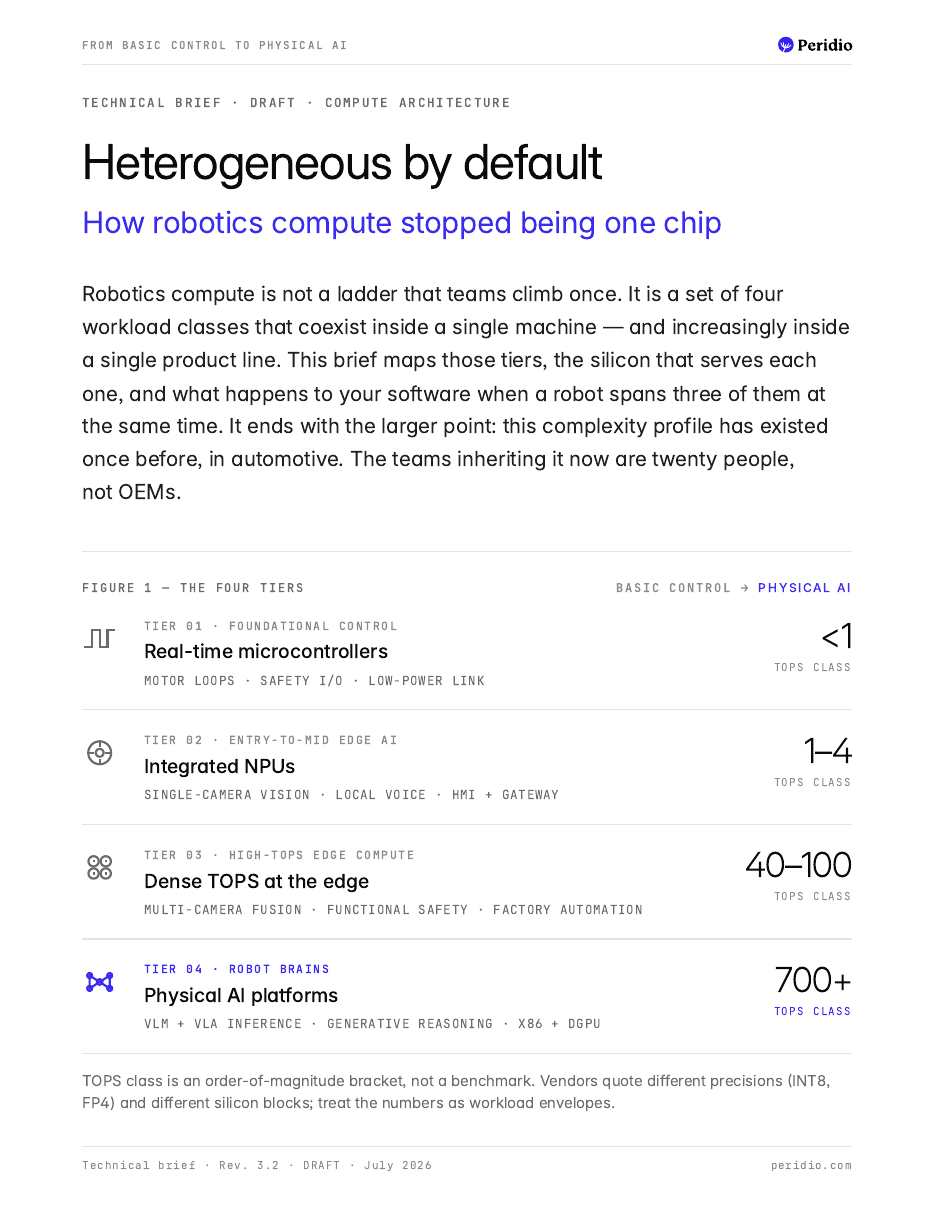
Figure 1 — Four tiers, one chassis
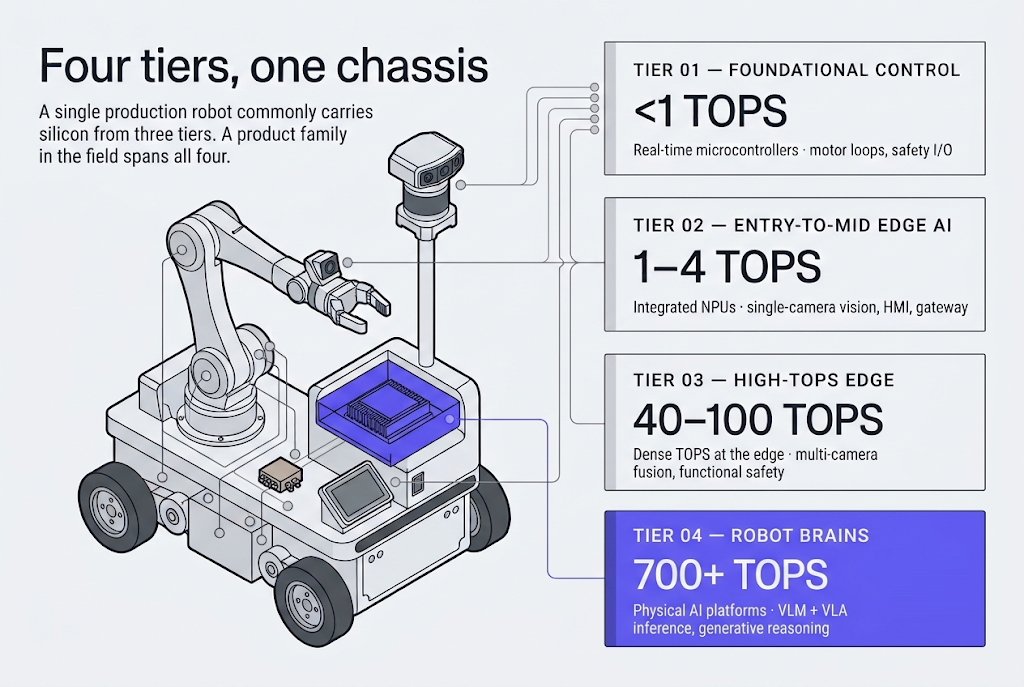
TOPS class is an order-of-magnitude bracket, not a benchmark. Vendors quote different precisions (INT8, FP4) and different silicon blocks; treat the numbers as workload envelopes.
01. Why tiers, not a spectrum
Compute selection in robotics looks continuous — more TOPS, more money, more watts — but in practice it clusters. It clusters because the constraints that matter change discontinuously. A motor loop needs a bounded worst-case response time, not throughput. A perception pipeline needs a memory bandwidth and an accelerated operator set. A foundation model needs enough dense compute to make a policy decision inside a control interval. Each of those constraints selects a different class of silicon, and the boundaries between them are sharp.
The practical consequence is that a single robot rarely lands in one tier. A mobile manipulator running a vision-language-action policy on a 700-TOPS module still drives its joints from a microcontroller, still speaks to its safety relay over a deterministic bus, and still reports battery telemetry from a low-power SoC. Four tiers, one chassis.
What follows is a map of the four classes: what each is for, what silicon serves it today, and the operational cost of spanning them.
02. Tier 01 · Foundational control
Determinism is the product
Real-time microcontrollers
Motor loops · Safety I/O · Low-power link
<1
TOPS class
The lowest tier is not a compromise; it is a different discipline. Microcontrollers here exist to close control loops at fixed intervals, drive motors and actuators, read encoders and limit switches, and hold a safety state when everything above them fails. There is no AI inference in this tier and none is wanted — a learned policy with a variable execution time is the opposite of what a joint controller needs.
Two families dominate. The STM32 line covers motor drives, industrial PLCs, medical equipment, and GPS platforms where reliable application control is the requirement. The ESP32 line trades some determinism for integrated Wi-Fi and Bluetooth plus ultra-low-power coprocessors, which is why it shows up in service robots, smart-home nodes, and sensor hubs that must sleep for months.
Design note
This tier is usually the last to get a real update path. Firmware ships by USB at the bench, then never changes. It is also where a field recall costs the most — the MCU is the part physically closest to the moving hardware.
| Part | Headline spec | Competitive strength | Trade-off |
|---|---|---|---|
| STM32F1 / F4 / L4 | Cortex-M3 / M4, 72–180 MHz | Ubiquitous tooling and a two-decade ecosystem; lowest cost per controlled axis. | No Linux, no NPU. Every feature is code you write and certify yourself. |
| STM32H7 | Cortex-M7 up to 480 MHz | Hard real-time headroom for multi-axis loops and closed-loop current control. | Approaching MPU cost and power without an MPU software stack. |
| Espressif ESP32-S3 | Dual Xtensa LX7, 240 MHz, Wi-Fi + BLE | Radio and MCU in one part; ultra-low-power coprocessor enables months on a battery. | The radio stack introduces timing jitter — not a determinism-first part. |
03. Tier 02 · Entry-to-mid edge AI
The NPU becomes standard equipment
Integrated NPUs
Single-camera vision · Local voice · HMI + gateway
1–4
TOPS class
The defining shift in this tier is that acceleration moved on-die. Application processors now ship a dedicated neural block — NXP's eIQ-supported NPU, Qualcomm's AI Engine — sized for one camera stream, a keyword spotter, or a classical vision pipeline with a learned stage bolted on. One to four TOPS sounds modest, and it is: this is the tier for perceiving a specific thing reliably, not for reasoning about a scene.
NXP's i.MX 8M Plus and i.MX 95 target Industry 4.0 machine vision and automotive connectivity domain controllers. Qualcomm's Dragonwing QRB2210 and IQ6 push efficiency, landing in industrial gateways, HMI panels, and entry-tier robotics running mainstream Linux distributions.
Renesas is worth watching here for a different reason. One of the dominant automotive silicon vendors is carrying that functional-safety and longevity DNA into robotics with the RZ/V line, and doing it on efficiency rather than peak numbers — roughly 10 TOPS per watt, which is what makes a fanless, heatsink-free vision design possible. The RZ/V2H is also the clearest illustration of why these brackets are envelopes and not product categories: its dense throughput lands between tier 02 and tier 03, and its two Cortex-R8 real-time cores sit on the same die as the AI accelerator — the convergence pattern described in §06, arriving a tier earlier than expected.
Where the software problem changes shape
Because these parts run a full Linux userspace, one board now carries five artifacts with five independent lifecycles: a kernel, a device tree, a container runtime, a model, and a vendor BSP. Each has its own release cadence — the kernel moves on upstream's schedule, the model on your training cadence, the BSP whenever the silicon vendor decides. Each has its own upstream, and none of them coordinates with the others.
Each also fails differently. A container that won't start is visible in seconds; a device-tree change that alters camera timing surfaces weeks later, in the field, as dropped frames. The dangerous one is the BSP bump: it can silently invalidate the other four, because it moves the kernel, the drivers, and the accelerator runtime underneath code that was validated against the previous combination. Tier 01 needed version control. Tier 02 onward needs a system of record.
| Part | Headline spec | Competitive strength | Trade-off |
|---|---|---|---|
| NXP i.MX 8M Plus | 4× Cortex-A53 + M7, ~2.3 TOPS NPU | The mature industrial default: proven Yocto BSP, wide module availability. | NPU operator coverage lags current model architectures. |
| NXP i.MX 95 | 6× Cortex-A55 + M7 + M33, eIQ Neutron NPU | IEC 61508 SIL 2 and ISO 26262 ASIL B, EdgeLock secure enclave, 15-year longevity. | Newer part — ecosystem and third-party modules still trailing 8M Plus. |
| Qualcomm Dragonwing QRB2210 | Quad-core, lightweight Linux | Cheapest credible entry into Linux-based robotics and interactive displays. | Roughly 1 TOPS ceiling; vision here is classical with a learned stage at best. |
| Qualcomm Dragonwing IQ6 | QCS615, ~1 TOPS class, industrial temp | Industrial-grade CV plus 10-year longevity at entry-tier pricing. | Qualcomm Linux and Ubuntu paths are narrower than mainline kernels. |
| Renesas RZ/V2N | 4× Cortex-A55 + M33, DRP-AI3 NPU, 4 dense TOPS (15 sparse) | Class-leading efficiency — 10 TOPS/W enables fanless, heatsink-free vision designs; integrated ISP. | DRP-AI3 toolchain is Renesas-specific; third-party ecosystem trails NXP's. |
| Renesas RZ/V2H | 4× Cortex-A55 + 2× Cortex-R8 real-time + M33, DRP-AI3, ~8 dense TOPS (80 sparse quoted) | Real-time cores on the AI die — a single-chip robot controller with automotive-heritage vendor longevity; 10 TOPS/W without active cooling. | The 80 TOPS headline is sparse — dense is ~8; the widest quoted-vs-dense spread in this survey. |
04. Tier 03 · High-TOPS edge compute
Dense compute that survives the plant floor
Dense TOPS at the edge
Multi-camera fusion · Functional safety · Factory automation
40–100
TOPS class
Between the integrated-NPU tier and the humanoid brains sits a band that is easy to overlook and commercially enormous: 40 to 100 dense TOPS, rated for extended temperature, with functional-safety features in the silicon. This is the tier that runs sixteen cameras in a sortation cell, fuses lidar and radar on an outdoor AMR, or holds a certified safety function alongside a perception workload.
Qualcomm's Dragonwing IQ8 and IQ9 are octa-core platforms with ECC memory and safety-island partitioning — 20 to 40 dense TOPS on the IQ8, 100 on the IQ9, with up to sixteen concurrent camera inputs. AMD's Ryzen AI P100 and Versal AI Edge parts target digital cockpits and sensor fusion with deterministic control from −40 °C to +109 °C. NVIDIA serves the same band from above: Jetson Orin NX at 157 INT8 TOPS in a 25 W envelope, and AGX Orin configurable from 15 W to 60 W — one module that can be specified as a dense-perception part here and as a reasoning part in the tier above. The engineering constraint here is rarely peak TOPS; it is thermals, certification evidence, and a ten-year supply commitment.
| Part | Headline spec | Competitive strength | Trade-off |
|---|---|---|---|
| Dragonwing IQ8 | QCS8275, octa-core, 20–40 TOPS dense | ECC memory and a physically separated real-time subsystem; −40 °C to +125 °C. | Mid-tier ceiling — heavy multimodal work needs IQ9 or the tier above. |
| Dragonwing IQ9 | IQ-9075 (QCS9075), 100 TOPS dense, up to 16 cameras | SIL-3-capable safety features, 10+ year longevity, Yocto and Ubuntu support. | Vendor software stack rather than mainline; porting effort is real. Qualcomm also quotes 200 sparse TOPS — not comparable to dense figures. |
| NVIDIA Jetson Orin NX | 157 TOPS INT8 sparse (Super), 8-core Cortex-A78AE, 16 GB, 10–25 W | The volume workhorse of this band: full JetPack and Isaac ROS at a 25 W ceiling, in a form factor small enough for an AMR or an inspection head. | Ampere generation and memory-bound — good for multi-camera perception, not for on-device VLMs. |
| NVIDIA Jetson AGX Orin | 275 TOPS INT8 sparse (248 industrial), 12-core Cortex-A78AE, 64 GB, 15–60 W | Overlaps this tier and the next: configurable from 15 W to 60 W, so one module covers a dense-perception SKU and a reasoning SKU. Industrial variant rated −40 °C to +85 °C. | Buys headroom you may not use, at Ampere-generation efficiency. No FP4, no MIG partitioning. |
| AMD Ryzen AI Embedded P100 | 4–12 Zen 5 cores, RDNA 3.5, 50 TOPS NPU, 15–54 W | x86 lets you reuse desktop toolchains; AEC-Q100 qualified, drives four 4K displays at 120 fps. | Watts per TOPS trails Arm SoCs; 8–12-core variants entered production July 2026. |
| AMD Versal AI Edge | Programmable logic + AI engines | Reconfigurable pipelines for sensor fusion and hard-deadline preprocessing. | FPGA expertise required; the longest development ramp on this list. |
05. Tier 04 · Robot brains
The era of physical AI
Physical AI platforms
VLM + VLA inference · Generative reasoning · x86 + dGPU
700+
TOPS class
The top tier exists because a new workload arrived: multimodal models running on the robot, in the loop, at interactive rates. Vision-language-action policies, on-device VLMs, and generative reasoning over a scene are not accelerated classical vision — they are datacenter-shaped workloads compressed into a 40 to 130 watt module bolted to something that moves.
NVIDIA's Jetson Thor quotes 2,070 FP4 TFLOPS on Blackwell silicon, purpose-built for generative reasoning and humanoid spatial awareness. Qualcomm's Dragonwing IQ10 pairs a quoted 700 AI TOPS — datasheets list 350 dense — with an 18-core Oryon CPU and support for 20-plus sensors across camera, lidar, radar, and IMU. AMD's Ryzen AI X100 pushes CPU core count alongside AI throughput for the most demanding autonomous systems.
Most fleets in the field today, though, run the previous generation: Jetson AGX Orin at 275 INT8 TOPS is the incumbent robot brain, and it will stay in production designs for years. That gap matters more than the headline benchmarks. A program that qualified on Orin and wants Thor-class reasoning is not swapping a module — it is changing GPU architecture, CUDA target, quantisation strategy, and thermal design at once, on a robot already in service.
What is genuinely new is the update cadence. Model weights change weekly; an operating system image does not. A tier-04 robot needs to accept a new policy without rebuilding its OS, and needs to reject one that regresses — automatically, in the field, on a subset of the fleet first.
| Part | Headline spec | Competitive strength | Trade-off |
|---|---|---|---|
| NVIDIA Jetson T5000 | 2,070 FP4 TFLOPS sparse (~1,035 dense), 14-core Neoverse V3AE, 128 GB LPDDR5X, 130 W | Deepest robotics software stack — CUDA, Isaac, GR00T. MIG partitioning isolates mixed-criticality workloads on one GPU. | 130 W and the thermal mass to match. CUDA gravity is a portability decision, not just a performance one. |
| NVIDIA Jetson T4000 | 1,200 FP4 TFLOPS, 64 GB, 40–70 W | Thor architecture inside a mobile power budget — the realistic humanoid module today. | Half the memory; large VLA models need deliberate quantization. |
| NVIDIA Jetson AGX Orin | 275 TOPS INT8 sparse, 12-core Cortex-A78AE, 2,048-core Ampere GPU, 64 GB, 15–60 W | The installed base. Years of hardened JetPack releases, every ROS 2 and TensorRT recipe already written against it, modules and carriers from a dozen vendors, and an industrial variant rated −40 °C to +85 °C. | Ampere-generation: no FP4, no transformer engine, no MIG. Large VLA models fit poorly, and the migration to Thor is a software project, not a socket swap. |
| Qualcomm Dragonwing IQ10 | 18-core Oryon CPU, 700 TOPS quoted | Highest quoted industrial throughput per watt, inheriting IQ8/IQ9 safety heritage. | Module datasheets list 350 dense TOPS — read the precision footnote. Ecosystem younger than Jetson. |
| AMD Ryzen AI X100 | 16 Zen 5 cores, 50 TOPS NPU, 55 W, up to 128 GB unified memory | Unified memory removes host-to-accelerator copies; AMD claims 3× peak FP32 over Jetson T5000. | NPU TOPS far below Arm rivals — the GPU carries inference, which complicates power budgeting. |
Throughput figures are vendor-published and use different precisions and sparsity assumptions (INT8, FP4, dense vs. sparse). Comparing headline numbers across vendors without normalising precision is the most common error in this tier.
The other tier 04: x86 plus a discrete GPU
Any survey that stops at integrated modules misses the configuration a large share of physical-AI robots actually ship with: an x86 host — a COM Express or NUC-class board built on Intel Core Ultra or AMD Ryzen Embedded — with an NVIDIA RTX GPU on PCIe or an MXM module beside it. It is not the elegant answer, and it is frequently the right one.
The reason is continuity. The policy was trained on x86 with an RTX card; running it on x86 with an RTX card removes cross-compilation, driver divergence, and the entire class of "works on the workstation" defects. VRAM is the other argument: 24 GB on an RTX PRO 4000 Blackwell SFF at 70 W, up to 96 GB on the larger RTX PRO parts, where integrated modules cap at 64 or 128 GB of shared memory. And the GPU is a replaceable part — a robot designed around a PCIe slot or an MXM socket can take next generation's silicon without a mechanical redesign.
The costs are equally concrete. System power lands between 150 W and 400 W, which means active cooling, filtered airflow, and a thermal design that survives vibration. There is no safety island, no lockstep core pair, and no automotive qualification on a workstation GPU — the safety function has to live on a separate controller, which puts you back in tier 01. Host-to-GPU transfers cross PCIe rather than sharing memory. And consumer or professional GPU lifecycles are short next to a ten-year industrial program, which is why embedded MXM vendors sell five-year lifecycle commitments as a headline feature.
| Part | Headline spec | Competitive strength | Trade-off |
|---|---|---|---|
| NVIDIA RTX PRO 4000 Blackwell SFF | 24 GB GDDR7, 70 W, dual-slot, low-profile | The sweet spot for edge inference: workstation-identical CUDA in a 70 W card that fits an industrial chassis. | Still needs a host, a PSU, and airflow. Nothing about it is rated for a moving platform. |
| NVIDIA RTX PRO Blackwell embedded MXM | RTX PRO 500 / 2000 / 4000 / 5000, MXM 3.1 Type B, 82 × 110 mm | Built for embedded integration — ruggedised modules with multi-year lifecycle commitments from ADLINK, Aetina and ZOTAC. | Socket and thermal solution are yours to engineer; module pricing carries an embedded premium. |
| NVIDIA RTX Ada / A-series MXM | RTX 2000 / 3500 / 5000 Ada, A1000–A4500 | Proven, widely deployed, and cheaper per GB of VRAM than current-generation parts. | Previous architectures: no FP4, weaker transformer throughput per watt. |
| x86 host — Core Ultra / Ryzen Embedded | COM Express or NUC-class, PCIe Gen4/5 x8–x16 | Bit-identical to the development workstation: standard Linux, Docker, ROS 2 binaries, no cross-compilation. | No real-time domain and no safety island — determinism and safe-stop move to a separate MCU. |
Read this configuration as tier 04 compute plus a mandatory tier 01 companion. The safety and determinism you get for free inside an integrated SoC becomes a second board, a second toolchain, and a second update path.
06. The multi-tier robot
Four tiers, four lifecycles, one machine
Read the tiers as a bill of materials rather than a roadmap and the operational picture becomes clear. A single production robot commonly carries silicon from three tiers; a product family in the field spans all four. Each tier brings its own toolchain, its own artifact format, its own signing story, and its own CVE surface. Nothing about that is exotic — it is simply four parallel software supply chains inside one serial number.
How it happens
Teams discover this at the second deployment, not the first. Nobody decides to build a four-tier system; it accretes, one reasonable decision at a time.
01 · Prototype
One dev kit. One toolchain. Flash it at the bench.
02 · Pilot
A second board for cameras — now two update paths.
03 · Production
A safety-rated controller joins, with its own certified artifact.
04 · Cost-down
A cheaper MCU variant ships, and four mechanisms must agree on one version.
There is one convergence worth naming. Across the mid and upper tiers, vendors are integrating the lower tiers back into the die — safety islands, separated real-time subsystems, dedicated Cortex-M or Cortex-R complexes sitting beside the AI engine. Qualcomm's IQ8 ships a physically and electrically separated real-time core cluster; NXP's i.MX 95 pairs its application cores with an M7 and an M33; Renesas puts two Cortex-R8 cores on the RZ/V2H beside its NPU; AMD's P100 argues determinism as a feature of an x86 part. The intent is identical in every case: when the generative model fails or stalls, something with a bounded response time still stops the machine. That does not collapse the tiers into one — it means a single die now contains two of them, each with its own lifecycle.
The hard problem in robotics compute is no longer picking the part. It is keeping four classes of silicon, four artifact types, and one fleet in agreement about what is deployed.
07. What the tiers demand of software
Independent of vendor, the same four capabilities show up on every serious multi-tier program:
One artifact model
Firmware blobs, OS images, containers, and model weights described and versioned the same way, so a robot has one answer to "what are you running".
Decoupled update paths
Shipping a model must not require rebuilding an OS image, and patching a kernel CVE must not invalidate a safety case.
Signed, verifiable provenance
Every artifact signed, every device able to refuse an unsigned one, and an audit trail that satisfies a certification body years later.
Cohorts and rollback
A canary cohort before a fleet-wide release, and a rollback measured in seconds rather than site visits.
None of these are properties of a chip. They are properties of the control plane sitting above the chips.
08. What this means
The four tiers are not a transitional state. They exist because four different constraints — bounded response time, accelerated perception, certified safety, dense reasoning — do not resolve into one piece of silicon, and there is no roadmap on which they will. Heterogeneity is the steady state, and the vendors are confirming it by putting safety islands and real-time complexes back onto their largest dies.
There is one industry that has lived with this profile for decades: automotive. A modern vehicle carries dozens of compute domains across every criticality class, updates over the air, and stays in service for fifteen years. Automotive absorbed that complexity slowly, with fifty years of Tier-1 suppliers, standards bodies, and certification regimes built to carry it. Robotics is inheriting the same profile with none of that scaffolding, from day one, at startup headcount. A twenty-person humanoid company now signs up for an electronics architecture that used to require an OEM.
That is what is being born: a machine category with automotive-grade architecture and datacenter-grade update cadence. Industrial and commercial operators will be the first beneficiaries. They have structured environments, supervised deployments, and customers who pay for uptime rather than novelty. Consumer comes later, and consumer is the point. The industry's obsession with robotics is, underneath, a bet that it becomes the next great consumer platform. The brands that intend to own it are securing their positions now, in the fleets they ship over the next five years.
The teams that win will not be the ones that picked the best module. The parts are documented, supported, and largely interchangeable within a tier. The hard problem moved up a layer, to coordination: keeping four artifact types, four release cadences, and four failure modes in agreement across a fleet that is already in service. That work does not show up on a spec sheet, and it is not optional.
Compute-tier decisions and software-architecture decisions can no longer be made in separate meetings.
Corrections, counterarguments, and figures we got wrong are welcome — the appendix is the page that ages first. Technical detail on managing multi-tier fleets lives at docs.peridio.com.
Appendix A — Cross-tier matrix
The same parts arranged on the axes that decide programs. Read A.1 for the envelope and A.2 for whether you can actually ship it.
Two views · 16 parts
| Tier / part | AI throughput | CPU + memory | Power envelope |
|---|---|---|---|
| STM32H7Tier 01 | AI throughputNone | CPU + memoryCortex-M7, 480 MHz | Power envelope<1 W |
| ESP32-S3Tier 01 | AI throughputNone | CPU + memoryDual LX7, 240 MHz | Power envelopemW-class, deep sleep µA |
| i.MX 8M PlusTier 02 | AI throughput~2.3 TOPS | CPU + memory4× A53 + M7 | Power envelope~5 W |
| i.MX 95Tier 02 | AI throughputeIQ Neutron NPU | CPU + memory6× A55 + M7 + M33 | Power envelope~5–10 W |
| RZ/V2NTier 02 | AI throughput4 dense / 15 sparse TOPS | CPU + memory4× A55 + M33 | Power envelope~2–5 W class |
| RZ/V2HTier 02/03 | AI throughput~8 dense / 80 sparse TOPS | CPU + memory4× A55 + 2× R8 + M33 | Power envelope~10 W class |
| Dragonwing IQ8Tier 03 | AI throughput20–40 TOPS dense | CPU + memoryOcta-core + RT subsystem, 24 GB LPDDR5X | Power envelope~15–25 W |
| Dragonwing IQ9Tier 03 | AI throughput100 dense / 200 sparse | CPU + memoryOcta-core, 36 GB LPDDR5X | Power envelope~25–40 W |
| Jetson Orin NXTier 03 | AI throughput157 TOPS INT8 sparse | CPU + memory8-core Cortex-A78AE, 16 GB | Power envelope10–25 W |
| Ryzen AI P100Tier 03 | AI throughput50 TOPS NPU | CPU + memory4–12 Zen 5 + RDNA 3.5 | Power envelope15–54 W |
| Jetson T4000Tier 04 | AI throughput1,200 FP4 TFLOPS | CPU + memory12-core Neoverse V3AE, 64 GB | Power envelope40–70 W |
| Jetson T5000Tier 04 | AI throughput2,070 FP4 TFLOPS sparse | CPU + memory14-core Neoverse V3AE, 128 GB | Power envelopeup to 130 W |
| Jetson AGX OrinTier 03/04 | AI throughput275 TOPS INT8 sparse | CPU + memory12-core Cortex-A78AE, 64 GB | Power envelope15–60 W |
| x86 + RTX PROTier 04 | AI throughputGPU-dependent; 24–96 GB VRAM | CPU + memoryCore Ultra / Ryzen Embedded host + PCIe or MXM GPU | Power envelope150–400 W system |
| Dragonwing IQ10Tier 04 | AI throughput700 TOPS quoted / 350 dense | CPU + memory18-core Oryon | Power envelopevendor-dependent |
| Ryzen AI X100Tier 04 | AI throughput50 TOPS NPU + RDNA 3.5 | CPU + memory16 Zen 5, up to 128 GB unified | Power envelope55 W base (45–120 W configurable); sampling, production Q4 2026 |
| Tier / part | Safety + thermal | OS and toolchain | Stated longevity |
|---|---|---|---|
| STM32Tier 01 | Safety + thermalSafety libraries; industrial temp | OS and toolchainBare metal, Zephyr, FreeRTOS | Stated longevity10+ years typical |
| ESP32-S3Tier 01 | Safety + thermalConsumer to industrial temp | OS and toolchainESP-IDF, Zephyr | Stated longevityLong, no formal program |
| i.MX 8M PlusTier 02 | Safety + thermalIndustrial temp | OS and toolchainYocto BSP, mainline-adjacent | Stated longevity10–15 years |
| i.MX 95Tier 02 | Safety + thermalSIL 2 / ASIL B, −40 to +125 °C | OS and toolchainYocto, Linux, Android; FuSa pack | Stated longevity15 years |
| RZ/V2NTier 02 | Safety + thermalIndustrial temp; integrated ISP | OS and toolchainLinux (Yocto-based Verified Linux Package), DRP-AI3 tools | Stated longevityRenesas longevity program (10+ yrs typical) |
| RZ/V2HTier 02/03 | Safety + thermalDual Cortex-R8 real-time domain on die | OS and toolchainLinux (Yocto-based Verified Linux Package), DRP-AI3 tools | Stated longevityRenesas longevity program (10+ yrs typical) |
| Dragonwing IQ8/IQ9Tier 03 | Safety + thermalSIL-3-capable, ECC; IQ8 −40 to +125 °C, IQ9 −40 to +115 °C (Tj) | OS and toolchainQualcomm Linux, Ubuntu, Yocto | Stated longevity10+ years |
| Jetson Orin NXTier 03 | Safety + thermalIndustrial variant available; A78AE cores | OS and toolchainJetPack, CUDA, TensorRT, Isaac ROS | Stated longevityVendor-stated per module |
| Ryzen AI P100Tier 03 | Safety + thermalAEC-Q100, industrial temp | OS and toolchainStandard x86 Linux, virtualization | Stated longevityup to 10 years |
| Versal AI EdgeTier 03 | Safety + thermalCertifiable flows available | OS and toolchainVivado / Vitis + FPGA skills | Stated longevityLong-life program |
| Jetson ThorTier 04 | Safety + thermalMIG isolation for mixed criticality | OS and toolchainJetPack, CUDA, Isaac, GR00T | Stated longevityVendor-stated per module |
| Jetson AGX OrinTier 03/04 | Safety + thermalIndustrial variant −40 to +85 °C; A78AE lockstep-capable cores | OS and toolchainJetPack, CUDA, TensorRT, Isaac ROS — the most documented stack in robotics | Stated longevityVendor-stated per module |
| x86 + RTX PROTier 04 | Safety + thermalNo safety island — needs a companion MCU; active cooling required | OS and toolchainStandard x86 Linux, CUDA, Docker, ROS 2 binaries | Stated longevityGPU 3–5 yrs; MXM vendors offer longer |
| Dragonwing IQ10Tier 04 | Safety + thermalInherits IQ safety architecture | OS and toolchainQualcomm Linux, Ubuntu | Stated longevity10+ years |
| Ryzen AI X100Tier 04 | Safety + thermalIndustrial-grade i variants | OS and toolchainROCm, standard x86 Linux | Stated longevityup to 10 years |
Safety and longevity claims are as published by each vendor and are not equivalent certifications. A "SIL-3-capable" feature set is not a certified system; the evidence package is still yours to assemble.
Appendix B — Sources
Figures verified against vendor publications in July 2026. Silicon roadmaps move quarterly; treat the appendix as the page that ages first.
- STMicroelectronics — STM32 32-bit Arm Cortex MCUs · https://www.st.com/en/microcontrollers-microprocessors/stm32-32-bit-arm-cortex-mcus.html
- Espressif — ESP32-S3 · https://www.espressif.com/en/products/socs/esp32-s3
- NXP — i.MX 8M Plus · https://www.nxp.com/products/iMX8MPLUS
- NXP — i.MX 95 applications processor family · https://www.nxp.com/products/i.MX95
- Qualcomm — Dragonwing IQ6 Series · https://www.qualcomm.com/internet-of-things/products/iq6-series
- Qualcomm — Dragonwing IQ8 Series · https://www.qualcomm.com/internet-of-things/products/iq8-series
- Qualcomm — Dragonwing IQ9 Series · https://www.qualcomm.com/internet-of-things/products/iq9-series
- Renesas — RZ/V2H · https://www.renesas.com/en/products/rz-v2h
- Renesas — RZ/V2N · https://www.renesas.com/en/products/rz-v2n
- AMD — Ryzen AI Embedded P100 Series · https://www.amd.com/en/products/embedded/ryzen-ai/p100-series.html
- AMD — Ryzen AI Embedded X100 Series · https://www.amd.com/en/products/embedded/ryzen-ai/x100-series.html
- AMD — Versal AI Edge adaptive SoCs · https://www.amd.com/en/products/adaptive-socs-and-fpgas/versal/ai-edge-series.html
- NVIDIA — RTX PRO 4000 Blackwell SFF · https://www.nvidia.com/en-us/products/workstations/professional-desktop-gpus/rtx-pro-4000-sff/
- ZOTAC — NVIDIA RTX PRO Blackwell embedded MXM GPUs · https://www.zotac.com/page/embedded-gpu
- ADLINK — MXM GPU modules · https://www.adlinktech.com/en/mxm-gpu-modules
- NVIDIA — Jetson Orin modules · https://www.nvidia.com/en-us/autonomous-machines/embedded-systems/jetson-orin/
- NVIDIA — Introducing Jetson Thor · https://developer.nvidia.com/blog/introducing-nvidia-jetson-thor-the-ultimate-platform-for-physical-ai/
- Qualcomm — Dragonwing QRB2210 · https://www.qualcomm.com/internet-of-things/products/q2-series/qrb2210
- Qualcomm — Dragonwing IQ10 Series · https://www.qualcomm.com/internet-of-things/products/iq10-series
- Qualcomm — Product Longevity Program · https://www.qualcomm.com/internet-of-things/products/product-longevity-program
- NVIDIA — Jetson Thor · https://www.nvidia.com/en-us/autonomous-machines/embedded-systems/jetson-thor/
- Intel — Core Ultra for the edge · https://www.intel.com/content/www/us/en/products/details/processors/core-ultra/edge.html
- AMD — Ryzen Embedded · https://www.amd.com/en/products/embedded/ryzen.html
- NVIDIA — Jetson module lineup · https://developer.nvidia.com/buy-jetson
About this brief
Written by the team at Peridio, which builds the control plane robotics teams use to ship operating systems, containers, models, and signed updates to fleets in the field. Silicon figures are vendor-published; tier brackets are ours. Corrections and counterarguments are welcome.
Changelog
- July 2026Rev 3.2 — initial publication of the technical brief.
Get the PDF
Take the brief with you.
The full Rev 3.2 brief — all five silicon tables, the cross-tier matrix, and the sources appendix — as a designed PDF you can send to your team. Everything on this page, formatted for review and circulation.
Drop your work email and we'll send the PDF over.